
Don't you blokes care about contra?
And the stadium in Victoria Park

Welcome to The Maroon Observer, a weekly newsletter about rugby league, Queensland and rugby league in Queensland.
The Olympic City
Things are starting to move. This time last year, I was calling Peter V’Landys a “giant embarrassment” because he forgot to get his pork barrelling application into the LNP government before the end of the 100 day review of the Olympics rugby league is supposed to be played in. V’Landys decided several hours after the outcomes of the review had been announced to make some vague threats about the future of NRL events in Queensland.
Those threats paid off:
Suncorp Stadium will be upgraded to meet demand ahead of the Brisbane 2032 Olympic and Paralympic Games, with Premier David Crisafulli committing to the venue’s transformation…
Mr Crisafulli said upgrades to Suncorp Stadium were a “very high” priority and evaluations were under way to consider further venue capacity.
We didn’t get a lot of detail as to what will be upgraded, or how much more capacity is going to be added, or how much it will cost, or how it will be funded. Let your imaginations run wild - 65,000 seats? 75,000? Something like this? Or this? - because Peter Beattie’s musings seem as realistic as whatever the LNP will cook up. The LNP selling off Suncorp to a land banking property developer that’s going to tack on a $5.95 fee ($3.95 for kids) for “premium air access” would be on-brand. Really, the last thing the Southeast economy needs right now is another tricky stadium refurbishment that is not strictly required for the world’s biggest sporting event that is six years away.
Crisafulli and his Foolies did get around to signing some contracts, which Labor failed to do, so they’re ahead of their feckless opposition. The first, just before Christmas:
Unite32, a joint venture between Laing O’Rourke and AECOM, has been appointed by the Games Independent Infrastructure and Coordination Authority (GIICA) as its Delivery Partner for the $7.1bn Brisbane 2032 Olympic and Paralympic Games Venues Infrastructure Program.
This appointment is a major milestone in delivering world-class venues and infrastructure for one of the most anticipated global sporting events. Unite32 will be responsible for delivering 17 new and upgraded venues and monitoring two other venues across Queensland, spanning from the Gold Coast to Cairns.
Then, shortly after New Year:
The Queensland government has revealed who will be responsible for designing the Victoria Park stadium ahead of the 2032 Olympic and Paralympic Games.
The 63,000-seat stadium will be designed by Australian firms Cox and Hassell, which will team up with Japanese group Azusa Sekkei.
If you know, you know, but Laing O’Rourke, Hassell, Cox and AECOM are exactly the kind of firms you would expect to have won these tenders. The only shock is that Populous were unable to wedge themselves in but there is still time. Building the Olympics is too big for any single organisation to handle, especially if the government applies its own local procurement philosophy. Spreading the work around will either be good or bad, depending on your level of trust of the industry (no comment).
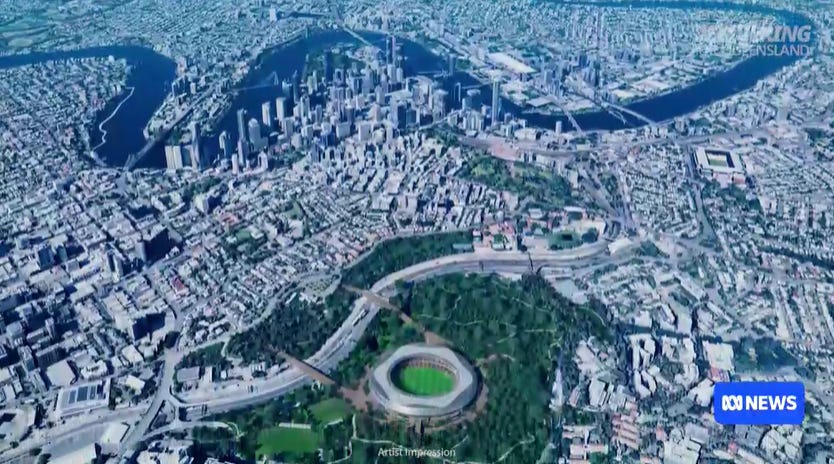
Is this an astonishing design that will revolutionise this city? No. It looks like Optus Stadium or, from a certain angle, a nut and washer. This is fine. We don’t need visionary. We just need it delivered without bankrupting or embarrassing the state.
What started as a $2 billion project to replace the Gabba and ended up somewhere north of $7 billion in the newspapers’ race to out-hyperbolise each other in the run-up to the election, has come back down to $3.6 billion. This is some fantastic - in both senses of the word - management of expectations but one wonders if a constant stream of hysteria about public works is healthy for the state of our infrastructure? Can’t see any long term repercussions there.
While $3.6 billion is an order of magnitude more than it cost to rebuild Suncorp 23 years ago, it is roughly on par with the cost to build Sofi Stadium in Los Angeles, which will perform the same function in 2028. The headline figure is still really high, and twice that of Perth Stadium, which was the most expensive stadium development in Australia by about half a billion dollarydoos. This sum is presumably linked to the Feds’ hard funding cap of $7.1 billion and hopefully includes some work to link the stadium to Cross River Rail, either with a new station or access from Exhibition.
You can look at the changes in the capex per seat figures over time and draw your own conclusions about the state of the industry (no comment). On the other hand, you can look at the renders for the new Penrith Stadium and consider how funny it is that the NSW government will get vastly different outcomes by choosing to spend roughly the same amount of money just seven years apart. The cheapest time to build something was yesterday and the second cheapest is now.
If Laing O’Rourke’s debut was any of concern - and they may choose a different contractor to build the stadium but that seems unlikely - the actual people on site correlates with project outcomes approximately a million times more strongly than which company they work for. Given how many will be involved, the quality of outcome is likely to reflect the average capability of the industry in SEQ, non-union conference (no comment).
Most of the things that people will complain about have already been decided or will be in the next 12 months. The general public are unlikely to notice defects in the workmanship, unless it is particularly shoddy or causes an actual safety issue, as opposed to the confected one the Daily Telegraph will roll out three days before the opening ceremony.
Let’s hear from some other complainers (my emphasis):
The project has attracted opposition from local group Save Victoria Park, which staged a small protest in front of the QUT building where today’s media conference was held.
About half a dozen supporters arrived with printed signs.
Whoa. That’s definitely an action group you have to take seriously. With such widespread popular support, this group has a significant mandate and therefore must be quoted in every story about the Olympics, despite representing two houses’ worth of people who live in the vicinity of Victoria Park.
When asked by journalists about the claims, Deputy Premier Jarrod Bleijie responded: "My response to Save Victoria Park? Loopy. Next question."
"Save Victoria Park are just a bunch of NIMBYs who don't want anything to happen. This park … was a golf course. Before it was a golf course, it was a dump for goodness sake," he said.
What you don’t want to do is have a less realistic view of the world than Jarrod Bleijie. Speaking of the member for Kawana, consider this headline:
Bleijie’s Indigenous ultimatum: Get on board or stay out of the way
With the actual quotes:
Infrastructure and Planning Minister Jarrod Bleijie has warned that he will activate the new laws if an agreement cannot be reached.
“Rather than just overruling those cultural heritage laws, I’ve actually put a provision in there that still honours those cultural heritage laws,” he said.
“But ultimately, if an agreement can’t be reached with local Indigenous communities, then the laws will be overridden.”
This is not much of an ultimatum, which would normally imply the action of the party making the threats will change depending on the decision made by the threatened. The government has made it clear that it doesn’t matter what Indigenous groups think and they can designate land to be exempt from its own laws at will. Fun fact: the casino on the Gold Coast is exempt from the state’s Smoking Act. Not being a lawyer, I am unclear to what extent federally legislated protections for Indigenous culture would be applicable but presumably the CFMEU et al are higher on the Crisafulli government’s risk register.
To briefly correct the record, Victoria Park was not formerly a dump, except perhaps metaphorically. What is now Victoria Park was an Indigenous gathering place. Settlers, such as those that came on the Fortitude, used as it as temporary accommodation before moving on. The obvious friction this created led to Vic Park becoming a site of resistance in the first decades of colonial Brisbane.
The local leader was nicknamed the Duke of York for his haughty bearing, which I take to mean he did not bow and scrape to the white people, and so the part where the ibises now live was known as York’s Hollow. Some recognition of this history, perhaps by referring to the stadium as Barrambin or someone working out the actual name of the Duke of York1, would be nice but is not going to happen in the current cultural and political climate.
With the Indigenous people driven off the land, Victoria Park was earmarked as green space for a city that has been historically obsessed with its access to gardens. The golf course was built in the 1920s. The park was used as temporary accommodation for the US army while Brisbane served as the general headquarters of the South West Pacific Area of WWII from 1942 to 19442. Those temporary buildings were retained and used as social housing after the war.
Unsuitable for human habitation, the social housing was demolished and after some re-greening undertaken, the site has been slowly chipped away. The railway to Sandgate (constructed in the 1880s), the Department of Electricity’s offices (now Energex on Bowen Bridge Road), the Inner City Bypass and the Northern Busway have reduced 64 hectares of space to 45. Presuming the stadium precinct is smaller than the golf course, the net green space added to the inner city is still positive, but less than what was anticipated when the Brisbane City Council announced they were closing the golf course in 2019, and before the Olympics were confirmed in 2021, hence the NIMBYs.
The next step is the athletes’ village. Cue Badellian hype from the Courier Mail’s editor:
Towers hosting more than 15,000 athletes for the 2032 Olympic and Paralympic Games will be squeezed onto Brookes St, Alexandria St and O’Connell Tce at Brisbane Showgrounds.
The Courier-Mail can also reveal construction on the athletes village, one of the most ambitious infrastructure projects of the state’s 2032 Games, is scheduled to start early next year.
Planning and design work is underway to determine how accommodation more than 10,000 Olympic athletes and 5000 Paralympic athletes will be constructed after the LNP government last March relocated the village from Northshore Hamilton to the inner-city showgrounds site.
The height of towers and how many will be required have not been confirmed, but an Royal National Agricultural Association spokeswoman said the buildings would be “predominantly” located along Alexandria St, which is located behind King St, O’Connell Tce and Brookes St.
The location makes some sense, although some athletes might have been better served with closer access to the Gateway from Hamilton, and so to venues on the Sunshine and Gold Coasts, than will be provided from a very congested Bowen Hills.
But once again, it is very convenient to see fast tracked planning permission given to a big developer for their prviate benefit. The 80s are back.
Thank you for reading The Maroon Observer
If you are enjoying this newsletter, or the horrifying amount of data available at The Almanac:

You may want to subscribe.
Better yet, maybe you would like to upgrade to a paid subscription. Paid subscribers get full access to the club newsletters, The Alamanac and The Dataset™, and can comment under posts. Your financial support keeps the lights on at The Maroon Observer.
Until kickoff in Vegas, annual subscriptions are 10% off.
If you don’t want Substack clipping your ticket or to commit to an ongoing subscription, Ko-Fi is also available for one-off tips.
Beardenda
Following on from last week’s post about the Bears, a big thank you to reader Ryan, who has sent me the constitution of the Perth Bears filed with ASIC, which provides some clarity about how this is going to work.
Most of the document is boiler plate, structuring a company that will hold the NRL licence and which exists to operate both genders of NRL teams. The Bears are not owned by anyone but will be controlled by its membership.
Schedule 4 outlines the criteria for triggering the transition to member control. In summary, the NRL team and its NSWRL teams have to be competitive for two years (in the NRL’s case, this means the Bears finishing in the top nine for two consecutive years), the WA state government has to provide the support it said it would, the club has to be an above average performer commercially, meet unstated rugby league participation targets in Western Australia and have a stable and deep roster (good luck!).
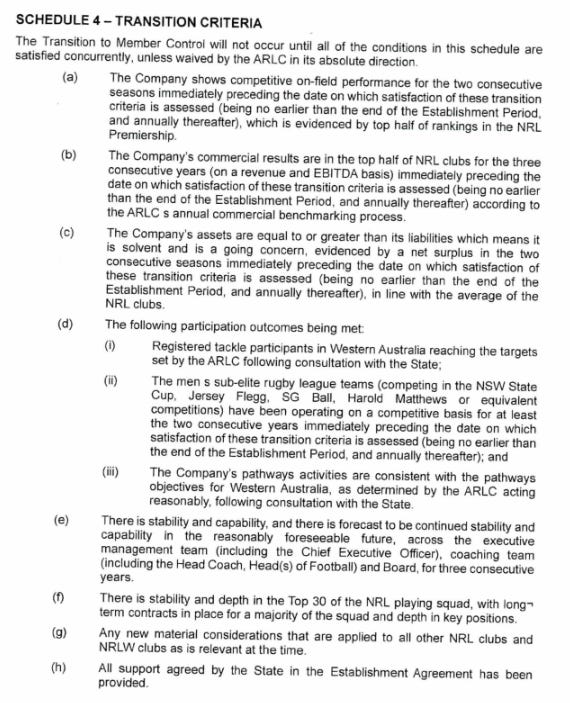
There are a non-zero number of current NRL teams that would not meet this criteria. It could be a while, possibly more than five years, before that criteria is met to the satisfaction of our great leader, Peter the Great the Short, who has sole discretion as to when the Perth Bears transition to member control and/or are sold. I also do not believe Peter V’Landys has sufficient ball knowing capabilities to judge the merits of a NRL roster.
Until then, there is one (1) member of Perth Bears Limited: the Australian Rugby League Commission. Under Schedule 3, the ARLC reserves the right to appoint the head coach and football general manager for the first three years. The ARLC must approve the appointment of the CEO, which would normally be the preserve of the board, and their C-suite, including their remuneration. The ARLC gets to determine the name of the team, its logo and colours. To tweak to what I wrote last week, it is apparently within the ARLC’s (you can substitute PVL here) remit to interefere in the club’s logo design, even though the existence of this remit is, at best, nanomanagement. The ARLC has to approve the club’s business plan, any employee drawing more than $300,000 in salary and any non-budgeted expenditure over $50,000.
Crucially, the ARLC has the right to appoint all members of the board, including the chair. The board has seven to nine seats, a third of which must be occupied by women and five must be occupied by “persons who reside in Western Australia and who identify as Western Australians”, including the chair. And you thought Queenslanders were parochial.
Of the current board, Ben Morton (failed WA Liberal), Peter Cumins (Cash Converters, WARL, Western Reds), Christina Matthews (former cricketer) and Emma Garlett (director of Garlett Group, an Indigenous consultancy) reside in Western Australia, which is one fewer than the constitution requires. V’Landys has two lackeys, John Dumesny from Harness Racing NSW and Jacqueline Johnstone, a former cop from Racing NSW. For the Bears, we have Joe Hockey (cigar smoker, former member for North Sydney), Daniel Dickson (to quote his LinkedIn, “a visionary entrepreneur”, and chairman of North Sydney Bears) and James Bracey (TV talking guy, Bears board member, seems fine and now I know his home address if not - SATIRE SATIRE NOT LEGALLY ACTIONABLE SATIRE).
Compare and contrast this to the recent Wests Tigers shenanigans over the summer and pending shenanigans at Parramatta.
After the transition is complete, the board will be completely turned over. Three directors will be elected by members, four appointed by the ARLC and two appointed by North Sydney. After that, the ARLC reserves the right to appoint one director, a huge and completely unjustifiable conflict of interest of governance, and the North Sydney Bears get to appoint two directors in perpetuity.
That lays out the landscape for the Bears’ politics. These arrangements answer some of the questions I’ve been asking but undoubtedly set the stage for new crises to emerge in future.
Quite what the board is going to do, when the ARLC holds all the cards, is up for debate. Home ground arrangements are determined by the board, and any resolution to change the home ground must be approved by 75% of the board. Given that 55% of the board must identify as “Western Australian“, this seems to preclude a move back to Sydney or relocation elsewhere. Soooo how many home games are the Bears expecting to play in Perth?
According to international news site City AM, Perth Bears CEO Anthony De Ceglie has indicated the NRL’s 18th franchise is open to playing matches in Singapore, capitalising on the two cities’ shared time zone while mirroring the well-known global aspirations of ARL Commission boss Peter V’landys.
“We are in a very different time zone to Sydney and Melbourne, we are in the economic Asian powerhouse time zone and that’s really handy for us,” De Ceglie said.
“I’d love to take the NRL to Singapore, it could be the Perth version of Las Vegas.”
Do you think he got approval from the ARLC to say that?
The TV deal
The new NRL broadcast deal, to kick off for the 2028 season, is going to be a simmering storyline through the year. Over the off-season, I took a very close look at the TV ratings of the NRL over the better part of the last decade.

If nothing else, another extremely healthy year of TV ratings should fill the NRL will confidence that they will soon be sitting on top of a HEAVING, ABSOLUTELY BOOMING WAR CHEST and help alleviate any concerns about the twin anchors of the Bears and the Chiefs. But who is going to fill the coffers?
We’ve seen a spray of articles, the kind that you get where the News Corp journalists spin a 10 minute phone conversation with V’Landys, where he says whatever he wants without push back, into four different storylines (e.g. conferences and wild cards, Netflix, taking over America, highest rating sport in Australia, no, the world), framed with a lot more emphasis and certainty than the facts warrant.
While I, too, would love a shorter season to reduce the sludge and open up some space for higher stakes rep games, there isn’t a single example of a sports league doing this. It would be earth shattering for the NRL to be the first. The notion alone might kill Blake Solly.
We’ll see a bid from Nine/Stan and/or DAZN/Hubbl and to preempt most of the following paragraphs, my hunch is that they will succeed. The deal from 2028 onwards is going to look a lot like the deal up to 2027, just a lot more expensive.
In terms of other potential bidders, Seven pick up the World Cup because it is played in the AFL off-season and a local World Cup is both relatively cheap and a relatively easy sell, but they can’t have the bandwidth, commercially or in the very literal sense of the word, to add a $3-4 billion deal with the NRL on top of a $4.5 billion deal with the AFL. While Seven could theoretically sell more ads, possibly at a premium to their rivals, its not just the cash. There’s a lot of other work that has to be done to produce the games and PVL loves his contra. I would say that makes Seven a non-starter.
Ten are owned by Paramount Skydance. Historically, Ten has been the third of three Australian networks, struggling to find a commercial foothold in a market that was never quite big enough. Churn in ownership over the last few decades has not provided firm strategic direction because no one can figure out how to turn around a nearly stranded asset that was never that healthy to begin with.3 It seems unlikely that anyone would invest beyond what it took to get the A-Leagues’ rights when they can just pump cheap American fare that they already own and clip whatever revenue that happens to generate.
As it stands, Ten’s parent company also have a bit on their plate, and it is beyond the scope of this newsletter to talk about the Ellisons, Oracle, TikTok, CBS News, Bari Weiss and how it all ties back to Trumper Dumper - not least because none of this is stuff that you really need taking up space in your brain - but the most recent story is a failed offer to take over Warner Brothers Discovery.
It looks like Netflix will beat Paramount to the punch, which will greatly expand their IP offering if nothing else, but will leave some assets with a rump of WBD. Netflix have been dipping their toes into live sports with the NFL and boxing. It is not really clear what’s going to come of that in the medium term. While the NFL forays have been relatively succesful, that is several orders of magnitude greater than the potential NRL audience.
Of the other streamers, Apple TV is going to pay a similar amount of money to the MLS as the NRL would be looking for, and have picked up some odds and ends, including a handful of MLB’s inventory. Disney and ESPN could be interested but Australia is a small market - our population is roughly that of the New York metro area - and our loyalties are divided between various sports in a way that the monolithic NFL precludes, so the value proposition for the Disney behemoth to attempt to capture market share for ESPN in somewhere like Australia seems to be extremely marginal and probably beneath their notice. But who knows? Paramount and Disney could do a combined Ten and ESPN bid with the money they find in the couch cushions, I just don’t think they would care enough to try.
Assuming no real threat from their FTA rivals, Nine have the advantage of being a protected species under anti-siphoning legislation and, if nothing else, will want Origin, the grand finals and most of the big ticket prime time games to keep them notionally relevant as they transition into Stan. This will keep a lid on the upper end of expected deal value.
On the other hand, losing the NRL would be close to a existential crisis for Kayo. They may survive with AFL and some cricket but that arrangement might not reflect the expected ROI in the spreadsheet for DAZN, so I expect a healthy bid to keep everyone else out with a corresponding jump in subscription pricing. Kayo, a service that has only improved around the edges since its launch in 2018, is going up to $46 per month for the premium offering, outpacing inflation by a solid 50% from its initial price. Contact your local NRL club for a digital membership if you want something cheaper.
Everyone seems to agree that live sports are valuable but no one seems to be quite sure how, and who, best to leverage that fact. A small player like the NRL could easily find itself turned into a fine dust by the gears of colossal market-makers as they grind their way to the new status quo, a reality that should terrify decision-makers who do not seem to be aware that this is a possibility.4 If this was 2018, we’d be talking about the NRL going it alone with their own over-the-top streaming but the orientation of the current administration’s policy is very clearly pointing another way.
Stats pop
Regular readers will be familiar with form Elo ratings. This is an Elo rating system that I’ve been using since 2017 that is optimised for head-to-head tipping and results in a relatively fast responing system.
It has a secondary feature, which is its ability to predict the outcome of games varies from season to season. One way to look at this is that seasons that have a relatively low success rate were objectively more unpredictable, as judged by the quantitative system not subject to the vagaries of human intuition, and vice versa.
Last season was the least predictable in the history of the NRL. Of course, this triggered a raft of proposed rule changes to make the game more exciting, despite the above, the premiers winning their finals games by a total of seven points and record ratings and crowds. Go figure.
Conversely, there was plenty of hand wringing about the future of women’s football if it remains as lopsided as it was last season. Of course, the NRLW has always been lopsided, and average margin increased to 17.5 from 13.9 in 2024, and people are masking the fact that they don’t like the teams on top.
Except they do, because the grand final rated over a million viewers, something that the much less maligned Knights were unable to do with their roster of bought stars in 2022-23. Then the Broncos lost half a dozen players to the Warriors but no one seems to be upset about that? Weird.
Notes
AI is transforming NRL recruitment, but there’s a hidden danger in the numbers. Irrespective of the minimal merits here, it is probably worth pointing out that there’s a difference between machine learning, which is glorified, automated linear regression; large language models, the chatbots that give people psychosis and can pretend to code5; and various other sub-applications which go under the heading “AI” for marketing and funding application purposes. I assume the academic quoted is largely referring to the former, rather than the latter, but the concerning thing about Big Data, The Cloud and AI is how these things were/are seen as revolutionary by the elite tier of the management class but are kind of just obvious things to do if the technology exists?
Suncorp Stadium set for AI-powered makeover ahead of 2032 Olympics. Uh-huh (the venue manager was idly speculating about what could be done to improve Suncorp, on the announcement of an extension of their contract)
Brisbane committee unveils new Olympic and Paralympic vision for 2032 Games. “Believe, Belong, Become — Brisbane 2032”.
South-east Queensland population to reach 4.5 million as growth outpaces that of the nation, KPMG analysis shows. “The analysis forecasts the south-east Queensland population will be as high as five million by 2036. But not everyone is flocking to Brisbane, with more than half of the growth happening outside the state capital.”
The “Duke of York Stadium” has some Epstein overtones no one wants.
Supposedly, unexploded ordinance was a concern in siting the stadium. Optimising the civil works to suit the gradient and the geology were also complicating factors that held up the announcement of the design.
It is great for my weekend mornings that there is basically a channel dedicated to Paw Patrol and Blaze and the Monster Machines though.
For example, I refer to the fate of the Pac-12. Super League may join them soon enough.
Some irony in the ‘learn to code’ crowd being the first to be automated out of existence.