
Then a strange thing happened
The Chiefs, changes to the rules, Super League and pub news

Welcome to The Maroon Observer, a weekly newsletter about rugby league, Queensland and rugby league in Queensland.
Chieves-tok
Just as the NFL dynasty of pure luck built by Andy Reid, Patrick Mahomes and Taylor Swift’s fiance fell apart in Kansas City, the good people of Papua New Guinea have selected the CHIEFS (Chieves?) to be the face of their country in the National Rugby League.
The Chiefs were the most anodyne option out of the shortlisted four - the Pythons, Chiefs, Angels and Crocodiles - which arose from an allegedly public vote. It’s fine, better than Angels, not as good as Crocodiles or Pythons, not particularly exciting and seemed to come together too quickly to generate any drama. The Courier Mail barely had time to claim any bombshells. Maybe it was that it was December and we’re seeing some expansion fatigue set in with the sickos.
Unlike the Bears, for whom we have a relatively clear picture of what’s going on, the Chiefs have a touch of mystery about them. Part of that is the distance, part of it is the cultural barriers and part of it is that a lot of things you would assume had been decided, in fact, hadn’t.
In 2024, I had a series of questions about the team we are now calling the Chiefs. A freedom of information request was submitted, not by me but someone else looking for similar information, to find out what was going on in the halls of power. The answer was: not a whole lot.
The threads of communication that we are allowed to see identified that the conditions of success were not defined and it was not clear how taxpayer funds would achieve those conditions, had they existed. Reading between the lines, it is very clear that Prime Ministers Albanese and Marape and one of Peter the Great the Short or the Abdobot agreed on the headlines of the deal ($600 million, ten years, rugby league, some vague hand waving) and then left the work of implementation up to public servants, who found themselves outside of their usual domain of expertise.
The Department of Foreign Affairs and Trade sought advice from the Department of Finance on the basics of structuring the deal and how the money would be delivered in such a way that could plausibly meet the very limited brief given.
Accompanying emails are redacted, the above is typical, but also includes this lovely one liner from DFAT:
Thanks for engaging Finance on this. I am probably eager to ensure that we have a clear understanding of what we mean by an investment and also how we judge value for money.
You and me both. Skipping through the series of emails to arrange everyone to jump on a call (on a weekend!) to get on the same page, here’s where they landed for March 2024:
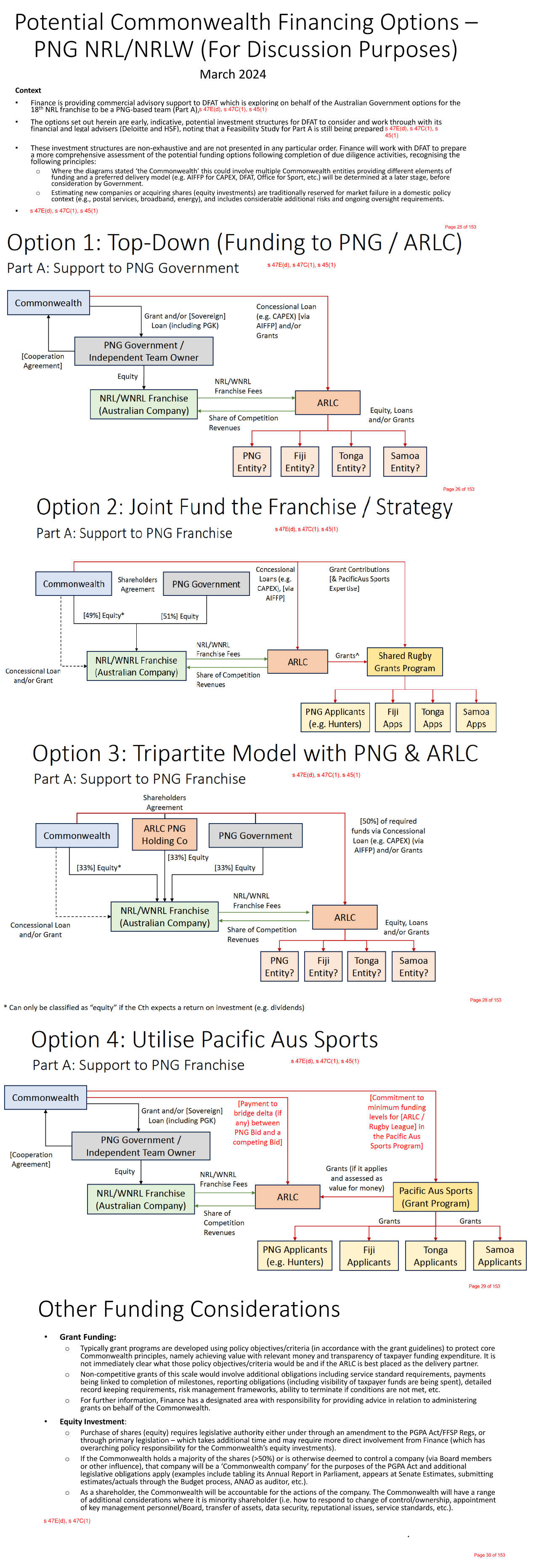
The kicker is at the end (my emphasis):
Typically grant programs are developed using policy objectives/criteria (in accordance with the grand guidelines) to protect core Commonwealth principles, namely achieving value with relevant money and transparency of taxpayer funding expenditure. It is not immediately clear what those policy objectives/criteria would be and if the ARLC is best placed as the delivery partner.
By June, DFAT undertook a second risk assessment. Here are some select quotes:
“There will be minimal financial benefit to Australia expected from the proposal.”
“The proposal will require innovative and ad-hoc funding arrangements to secure Australia’s interests.”
“New construction of accommodation, stadium upgrades and centres of excellence will be required in a difficult operating environment in PNG.”
“Overal Risk (including mitigation): Very High”
In summary, all the questions I had were the same questions people much closer to the proposal had. The rugby league media class was evidently too busy taking junkets to concern themselves with any of this.
A second FOI request resulted in 120 pages of released documents that were either redacted or the kind of boring procurement wrangling that the underemployed white collar workers that I assume make up a majority of my audience would be familiar with. As a result, Deloitte managed to extract nearly $2 million in fees by providing “commercial advisory services… relating to a National Rugby League (NRL) proposal.” Good work. I would’ve done something similar for half that.
Various dribs and drabs have leaked out and resolved into a slightly clearer picture since the initial announcement. Thanks again to reader Ryan, we know that there is a private company established in Papua New Guinea called PNG Chiefs Limited.
PNG Chiefs Limited, formerly known as “Australian Rugby League Commission (NRL franchise) Limited”, has one shareholder, Australian Rugby League Commission Limited, headquartered in Moore Park, Sydney. The ARLC has another local company, Australian Rugby League Commission (PNG) Limited, whose directors are Kate Jones, Wayne Pearce and Michael Sullivan. It is unclear where the taxpayer funding will be injected, as the PNGRFL also has entities that could be used, or how the funding will be distributed but it is clear that the Feds opted against taking equity in the Chiefs.
The directorate of PNG Chiefs Limited comprises Catherine Harris (chair replacing Ray Dibb), Ian Tarutia (Harvard Business School graduate whose resume includes Kumul Petroleum, BSP and nasfund), Lorna McPherson (CEO replacing Andrew Hill), Marcus Bai (needs no introduction), Richard Pegum (a prominent racehorse owner and breeder - hmmm - executive chair of Pacific Lime and Cement) and Stanley Joyce (retired managing director of South Pacific Brewery). McPherson, Joyce and Tarutia gave PNG addresses but unlike the Bears, it is unclear if there are residential restrictions on who can serve as directors.
The turnover of the chair, the CEO and one of the directors in the space of eight months may not fill you with confidence. Andrew Hill left quietly for a job in Sydney with Panthers Leagues in August. You may recall Wapu Sonk, who we discussed last July, was the subject of corruption allegations and was asked to resign by James Marape. Two weeks ago, Ray Dibb “claimed he was sacked from his role and did not quit.”
“I am disappointed I was unable to complete my tenure with the PNG Chiefs, as I had always intended to see our journey through. I did not resign because I believe in PNG and its people…
“My gratitude also goes to the PNG Chiefs board members who supported me, the PNGRFL, the NRL staff and to Nick Politis for recommending me for this opportunity and for his support.
I don’t know if this is instability, so much as shedding people who might have been useful to get the licence across the line but are at sea in dealing with Papua New Guinea. It remains difficult to judge the resumes, and notwithstanding McPherson’s involvement with inaugurating the Digicel Cup and Harris was a commissioner on the ARLC from 2012 to 2018, you’d think more experience with corporates and PNG is probably better for the kinds of non-football challenges the Chiefs are going to face in their first years than what clubland guys from western Sydney can offer. Perhaps if there are any further changes, then start worrying.
Interestingly, it should not be overlooked that the most masculine of enterprises, a footy club, in one of the most misogynistic countries in the world will be primarily run by two women. Progress?
That is, of course, presuming their new general manager for football, Michael Chammas, knows ball. I’m fairly confident he doesn’t have the experience to succeed in this role without a long runway that he doesn’t have, despite Brent Read’s I-don’t-know-what-you’d-call-this but it sits in the same genre as his unseemly and embarrassing promotion of Seibold for the Manly job, a move that has gone swimmingly. It is one of the strangest appointments in my time covering the sport, and has the potential to be the funniest.
Back to rugby league, which ostensibly is what this newsletter is about and not governance and boardroom appointments, Darren Lockyer raided the PNG Hunters’ roster during the off-season and took a bunch of them to London, including Morea Morea, Alex Max, Robert Mathias, Epel Kapinias and Gairo Voro. As reported by Steve Mascord:
“The Papua New Guinea boys, six of them live together in a house,” Demetriou tells rugbyleaguehub.com Long Reads in an office he uses at the Hazelwood Centre. “On Christmas Eve, the neighbours came around and were singing Christmas carols.
“Alex Max opened the door and he got all the boys down there and they were just blown away by these neighbours singing songs to them.
“They ended up getting to know the neighbours and joined in and went around the neighbourhood doing Christmas carols with them and then got invited back to their place for snacks and stuff.”
Livewire halfback Gairo Voro arrived in one of the world’s busiest cities with barely a word of English. And he spoke a different dialect from his fellow Kumuls, too. Team-mates and coaches have been stunned by his linguistic progress since.
Voro doesn’t even speak the language of his countrymen. We like to harp on about rugby league’s diversity and multiculturalism but I don’t believe we (the white we) are prepared for the culture shock of the Chiefs.
The Broncos are 2-0 under Lockyer’s ownership and new coach, Jason Demetriou, having conceded just 20 points to Widnes and Oldham. London are favourites to take out this year’s Championship, although, as is typical with English rugby league, no one knows whether that will mean promotion to Super League.
Unlike Judah Rimbu, who is playing for Easts in QCup this year before rumours have him heading to Perth, these players are likely getting a European gap year or two in preparation for being the core of the Chiefs.
Reading back on what I wrote pre-announcement, I’m surprised at how pessimistic I was about the whole enterprise but now we’re well underway, I’m struck by how pessimistic everyone else is.
This is going to happen. It may not meet your criteria for “success” (or mine, or perhaps the government’s or the NRL’s, whatever they may be) or “sport” or “sensible policy and diplomacy” but I am confident that by 2030, a NRL season featuring the PNG Chiefs will have been completed.
There are too many egos on the line for it to be otherwise.
Hello
The philosophy of The Maroon Observer is that I provide the kind of coverage that I want to read. I write about what interests me - business, expansion, politics and the actual football - in the hopes that others are also interested and find it useful. I look at stories from a different angle and take data and evidence from unusual places, like reader-submitted PNG IPA records or going deep into the statistical weeds, to put together a story that is unlike anything else in the rugby league sphere.
It is worth writing and it is worth reading, so subscribe to get all future posts in your inbox.
Rule changes
Oh good, we are doing these:
Interchange rules – Teams may interchange four players, up to eight times per match, from a squad of six players (players 14 to 19 inclusive).
Accidental breach (“zero tackle”) in-goal – There will be no seven-tackle set following a knock-on in-goal by the attacking team.
Restarting the tackle count – For certain infringements beyond the 20-metre line, the tackle count will restart, replacing the current 40-metre threshold.
Trainer rules – Trainers will be restricted from entering the field of play to prescribed and clearly defined circumstances. This will ensure player safety remains the priority while reducing unnecessary intrusions by Trainers carrying messages.
Most of my frustration was targeted at the kick off rule and that has been given the National Reserve Grade treatment, and delayed for an end of year trial, as hoped.
Some of my frustration was reserved for the set restart changes for reasons that should be fairly obvious but can be briefly summarised as “more set restarts makes for worse football”. Rugby League Eye Test has done plenty of work in this field.
While the clubs were supportive of the interchange, accidental breach and trainer rules, they had some reservations about the six-again change.
Changing the 40m threshold is expected to further speed up the game, resulting in fewer penalties and stoppages.
So there’s your justification. If the game speeds up and there’s fewer penalties, then it is mission accomplished. The second order impact on average margins will be there to be seen, along with the negative impact on predicatability of the season, but it is simply too much for our great leaders to remember five years ago, when they made the sport a complete free for all, and the shambolic and incredibly boring effects.
Other than the lateness of the change - pre-season starts in a few days and it would be, to quote Nick Campton, “nice to know how many players are on a team” - I am less concerned with the changes to the bench. There is some evidence that teams incurring early head knocks to backline players were suffering disproportionately due to the lack of replacements. Increasing the available interchange to six mitigates this risk.
This will have other impacts in the sport, especially on reserve grade, as fewer players will be available to play Cup while not getting much in the way of NRL game time, but exactly what that looks like will only become apparent over the course of the next season.
Intermission
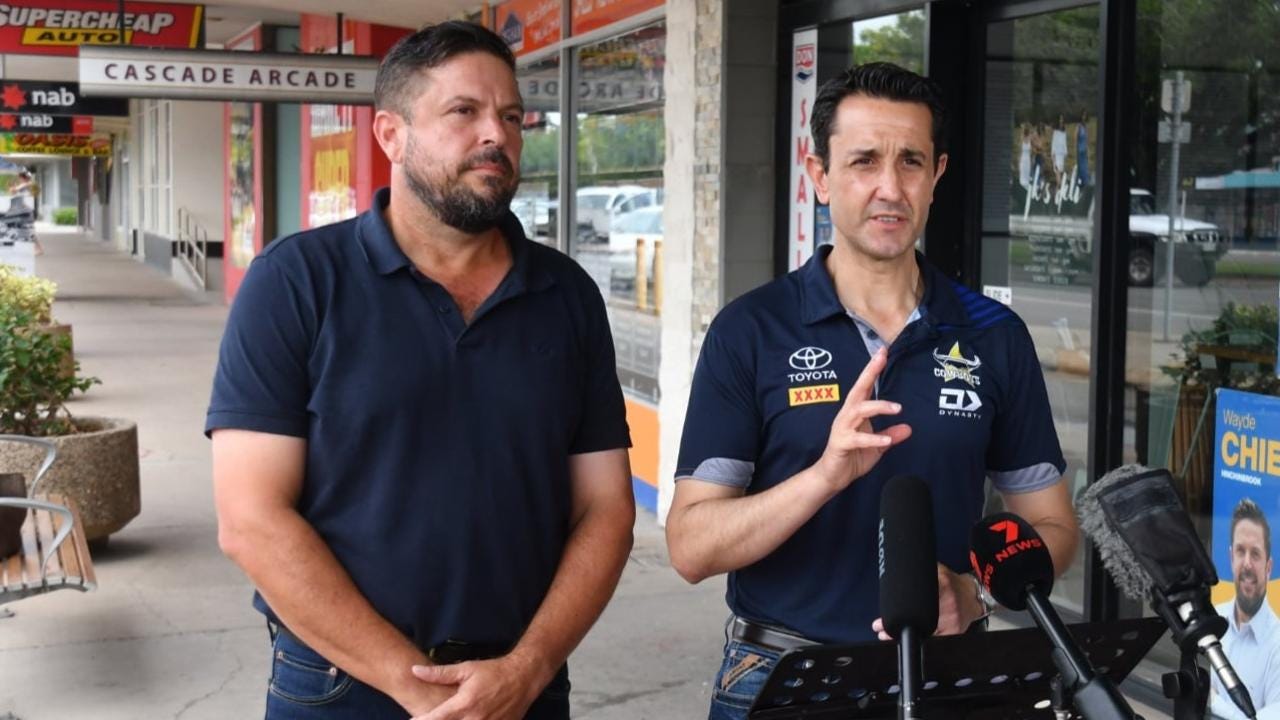
That’s the member for Broadwater, which is on the Gold Coast, on the right, wearing a Cowboys polo? Could you please be a bigger try hard while campaigning up north, Ingham boy? Shouldn’t you be locking some children up?
I’ve seen this man front the Broncos premiership celebrations at Suncorp, make a Queensland Day appearance at halftime of a Dolphins game and now this. I have not seen him anywhere near the Titans, the NRL club of his electorate. Draw your own conclusions.
Things are getting SHIFTY
If you want to test the tautness of your tether to reality, I suggest sitting down and watching two to three hours of Adam Curtis documentaries every night for a week and see what pitch that tether twangs at after, or if it has been severed entirely.
If you’re familiar with Curtis’ work, and “documentaries” is not quite the right word, as these are not works of pure fact, but neither is “film“ nor “video”, then you’ll recognise that I have subsumed his world view into my own over the last 15 years or so. And that ideas I had thought were my own, can be rephrased in his cadence.
Curtis has an extremely distinct style of visual collage, the product of unending time spent going through archives and rushes. Coupling bold text with ultrareal footage and interspersing the old and new, mundane and important, staid and violent, paired with off-kilter musical choices, gives his entire output ethereality, the texture of a dream and the consistency of a fairy tale. Which, I realise now, is the point. The medium is the message and all that.
Curtis’ latest series is Shifty, the story of the decline of Great Britain at the end of the 20th century. Despite dropping his trademark narration in Russia 1985-1999: TraumaZone1, Shifty hits all the usual beats. Post-war de-colonisation unleashed strange forces on the world and the old political elite were unable to deal with the new order. Instead of attempting to solve this, Thatcher and the other politicians turn to de-regulation, handing power to the bankers, while departing for a make-believe world of nostalgia. Individualism, aided by improving computer technology and the internet, atomised society which only worsened the political and economic chaos caused by de-industrialisation. Now, we are helpless, as we are unable to imagine a different way of ordering things. In summary:
Edwina Currie wrote “We politicians aren’t slaying dragons any more, now we’re just cleaning up the shit they leave behind.”
Being more focussed, on just one era in one place in contrast to Can’t Get You Out of My Head’s sprawl across China, Russia, the US and UK, and because the English are certifiable, Shifty gives us notes of fear, paranoia, racism, transphobia, conspiracism, corruption, incompetence, Joy Division and an uncomfortably candid look at the lives of ordinary people with at least one laugh out loud moment of absurdity per episode. Curtis doing a full series on Epstein would hit like crack.
Anyway, I had one of my patented let’s-bring-everything-back-to-rugby-league moments somewhere during episode four of the fever dream. The parallels between Britain’s leadership at its highest level in Parliament and at its lowest - that is, at the RFL - are obvious to any reader that’s followed my work over the last half decade.
The English rugby league system is so chaotic because it has leaders who do not understand the situation in which they find themselves. Even experts like Tony Collins can identify the problems clearly enough but fail to propose useful solutions (setting a crowd attendance benchmark doesn’t do anything). The RFL’s tweaking of grading systems to include more sporting merit is the kind of thing that would get you thrown of out most league boardrooms around the world for so obviously missing the bloody point: there isn’t enough money. The brain drain, the incompetence, the short termism, all of it can be traced back to that central point.
Say what you like about PVL, and I have, he at least has a firm grasp on who his stakeholders are and what they want, and then how to get them that. As a result, he has money. Note you are not a stakeholder, so your wants do not matter. So it was kind of interesting watching PVL go to work on the English during the Ashes:
“We’ve got no preset views - we’re here to listen and to see how we can help,” V’landys, interviewed in a hotel meeting room, said.
“But I’ve got to say, looking at the situation here: if they don’t do something, it’s dire.
“And it can be fixed. It’s not as though it can’t be fixed. But you’re going to have to be really disciplined and act in the best interests of the game as a whole if you’re going to get there.
“Because if there’s too many people going in different directions and not wanting to band together then basically … I can’t see how they can survive.
PVL used the stick of World Cup debt payment on behalf of his lackey, Troy Grant at the IRL, to put some pressure on the RFL, while apparently dangling the carrot of greater central distributions (up to £2 million), also while claiming “we’re not here to use any leverage.”
Everyone was quite happy to talk, and was happy that they talked, but no one wanted to commit. V’Landys is right that the English need to do something but it seems not to have quite reached the kind of crisis required for Super League to hand a third of itself over to the NRL for nothing:
“Those had never been more than ideas,” V’landys said.
Asked if all-out rebellion and headhunting clubs had ever been considered, V’landys said: “Any approach is possible but that is the one that we would least want.
“We certainly don’t want to be part of that.
“I think what they’ve got to do is band together. They’ve got to put their self-interest aside. They’ve got to put what’s best for the game (first).
“Because if they just go with self-interest, in the end they’ll have nothing as well.”
Most of the ideas floated in the lead-up had been those of Shane Richardson, the now ex-CEO of Wests Tigers, but these were given the patina of being NRL policy by confused reporting. V’Landys was more open about the need to set up an independent commission in England, in the shape of the ARLC, because despite all available evidence, V’Landys is a governance expert and would love to plant a bunch of directors with a background in NSW horse racing to represent his interests.
2025 Super League did well commercially, at least according to their own press release, as long as you don’t worry too much about things like Featherstone going under shortly after Salford’s rolling financial disaster. For 2026, Super League has expanded to 14 teams and combined the lower two divisions into a single 20-team competition. This looks a lot like what I proposed at the end of 2022, with the notable difference that they arrived at it completely ass backwards.
The change was made mostly for scheduling purposes. It ensures 27 rounds that is mostly home-and-away fixturing, instead of the additional third fixtures that were being played and clogging up the calendar with too many repeats. Of course, playing fewer games, or pulling on the policy levers, never seems to have entered the calculation.
Sky wasn’t consulted on the competition structural changes and may not be paying for a seventh game per week. It is rumoured they may not be interested in rugby league at all after 2027. Bradford, Toulouse and York, the teams promoted on sporting and non-sporting merits, to replace Salford and expand the league, are only taking a part-share of the central distribution.
Where that all lands is anyone’s guess but if the rumours about Sky come to pass, the English will be cap in hand, looking for a NRL bailout. Then things get shifty.
Hello again
If you particularly enjoy the newsletter and want to support it financially, you may want to consider an upgrade to a paid subscription.
Paid subscribers get full access to the club newsletters, The Almanac and The Dataset™, and can comment under posts. Your financial support keeps the lights on at The Maroon Observer.
For a limited time, until the kickoff of the NRL season in Vegas, annual subscriptions are 10% off.
If you don’t want to commit to an ongoing subscription, Ko-Fi is also available for one-off tips. You can also use Ko-Fi for a recurring subscription if you don’t want Substack clipping your ticket and I will arrange for access separately.
Programming notes
Firstly, sharp observers might have noticed a few minor changes in the way TMO is presented. If you didn’t notice, some of the fonts are different. Also, the Phin Review is coming, which should thrill the four Dolphins fans. The plan is to drop a club newsletter every two weeks, rotating between the Broncs, Cows and Phins, so you should get a Pony Picayune every six weeks, instead of every month. I am hoping a slight reduction in frequency guarantees something interesting to write about in each post but I am not confident that the Bovine Bulletin will bring much joy in 2026.
Secondly, I will be overseas for three weeks, starting Easter, so you might notice a drop-off in April. I am not anticipating being able to watch much footy in this period but we will see what happens. I may have more time than expected to fill in.
Finally, The Almanac is live. I gestured at this for paid subscribers towards the end of last season, as a replacement for proposed dashboards that I never really got off the ground, and I am hoping this will be easier to manage the absolutely deranged amount of data I have collated, processed and want to share.
Over time, I will be adding tables and charts for advanced metrics for paying subscribers and some coaching charts in the genre of The coaches that fucked up your club, so it is better to think of The Almanac as a constant work in progress than something that will be completed.2
Notes
Analysis: NRL sparks confusion with major rule-shake up days before pre-season. This is pretty poor analysis or poor editing, not sure which. For example, the introduction of the set restart was not trialled, it was dropped in for round 3 of 2020 and we were all expected to live with it.
This week in China: China’s space aircraft carrier: superweapon or propaganda? Oh you think Chammas and the Chiefs are going to stop a 120,000 ton space carrier? Do you think they’re up to that?!
This week in visas: New visa package for PNG Chiefs entry to NRL. A 12 month visa to come to Australia for AU$25… isn’t this the kind of thing that gets rorted? Why don’t we cut to the chase and give them the same status as the Kiwis?
I don’t think you should legally be allowed to write things along the lines of “After eight concussions, a Maroon retired at 30. Now new headgear offers hope to others” like Ninefax have done. Headgear doesn’t prevent concussions. The TGA needs to get on this quackery.
Gold Coast warned it faces traffic gridlock without major shift to public transport. They vote for it, I assume they like the gridlock. It’s a part of the local culture, like bikie bathtub speed and woowoo wellness influencing.
Antony Green runs a good blog: House Results in Queensland
Beer corner
More pubs than beers:
Billionaire Sydney Roosters chairman Nick Politis has purchased Queensland’s most iconic pub, the Caxton Hotel.
The paperwork has been signed in recent days in a $50 million deal with the Farquhar family, who have owned the famous rugby league hotel for 28 years…
His company, SEQ Hospitality Group, owns eight hotels and 20 bottle shops including the QA in Fortitude Valley, Tree Tops in Wests Burleigh, the Boathouse in Coomera, the Ashmore Tavern, Aspley Tavern, The Plough Inn, and The Court House Hotel in Murwillumbah.
I did not realise that Politis was a fellow alumnus of UQ (I did not go to Ipswich Grammar), although I graduated somewhat (nearly half a century) later.
Further up the street, as told by a Gambaro because there are only three families in this city apparently:
The Milton is being built as a full-time local, centred on food, atmosphere and a strong sense of community, while also positioning itself as a go-to venue for major events and game days. A rooftop area with views towards Suncorp Stadium will form part of the offering, but Melbourne Storm star Munster said the focus was on creating a pub people would want to return to seven days a week.
Between the ARLC, Politis and Munster’s group, half of Caxton is going to be owned directly by rugby league money. The Milton replaces Kittens strip club.
Which has the effect of making you watch it properly, lest you miss crucial context for why you’re being shown e.g. a bunch of skinheads fighting each other despite the protestations from organisers that “we’re all white”, or the macabre discovery of a dead body, who was actually a fighter pilot from WWII, in Kent.
While I could invest a lot of time and effort in making this look and function better, that would leave very little time to actually analyse and write about the data.